
How to Choose Australian Made Fishing Clothing for Kids
Last Updated: October 31, 2026
Quick Summary
Australian made fishing clothing for kids is apparel manufactured in Australia, not merely designed here, so check the care label or swing tag for a country-of-origin statement rather than trusting a flag graphic or product page headline. Verify the UPF rating and its testing standard, get the fit right, and care for the garment so it keeps performing.
- Designed in Australia describes where artwork was created; made in Australia describes where the garment was cut, sewn and finished.
- Size by height first if your child is tall, or by chest if they are broad, using the brand's own size chart.
- Buying a size up to grow into is the most common sizing mistake, as oversized sleeves can cover hands near hooks.
- Rinse garments in fresh water after each trip and wash cool with mild detergent, avoiding fabric softener and hot dryers.
- Judge value on cost per season, verified sun protection and return terms rather than the sticker price alone.
Table of Contents
- Why Australian Made Fishing Clothing for Kids Matters
- UPF Fishing Shirts for Kids: What the Rating Actually Means
- Lightweight Fishing Shirts for Children: Fabric, Breathability and Quick Drying
- Kids' Fishing Shirt Sizing: Getting the Fit Right First Time
- Durability, Care and Comfort for Real Fishing Trips
- What Australian Made Fishing Clothing for Kids Should Cost
- Join the Tide: Building a Sun-Safe Kit for Young Anglers
- Frequently Asked Questions
Why Australian Made Fishing Clothing for Kids Matters
Australian made fishing clothing for kids is apparel manufactured in Australia, not merely designed here, and the distinction decides what you are actually buying. The difference shows clearly on care labels. A shirt labelled "designed in Australia" can be cut and sewn overseas; a shirt labelled "made in Australia" was manufactured here. Parents searching for sun-safe clothing for young anglers deserve to know which one they are holding.
Made Here vs Designed Here: Reading the Label Honestly
The label is the first test, and most shoppers skip it. Look for a country-of-origin statement on the care label or swing tag, not just a flag graphic on the front. "Designed in Australia" describes where the artwork and patterns were created. "Made in Australia" describes where the garment was cut, sewn and finished. Those are different claims, and only one of them is a manufacturing claim.
A common mistake is trusting the product page headline instead of the label itself. If a brand cannot tell you where a garment was manufactured, treat the Australian angle as marketing rather than fact. The ACCC guidance on country of origin claims sets out what businesses can and cannot say about where goods are made, and it is worth a read before you spend up on a full kit.
UPF Fishing Shirts for Kids: What the Rating Actually Means
UPF fishing shirts for kids carry a rating that measures how much UV radiation passes through the fabric to the skin. Higher UPF ratings block more UV than lower ones. The rating applies to the fabric as new, which is why care matters as much as the number on the tag.
Checking Sun Protection Claims Independently
Sun protection claims should be backed by testing to a recognised standard. Ask whether the rating was tested on the fabric as supplied, and whether the brand re-tests after washing. A shirt that starts at UPF 50+ and drops after a season of saltwater rinses is not delivering what the tag promised.
For parents who want the longer explanation, how to choose UPF fishing apparel covers ratings, fabrics, fit and care in depth.
Lightweight Fishing Shirts for Children: Fabric, Breathability and Quick Drying
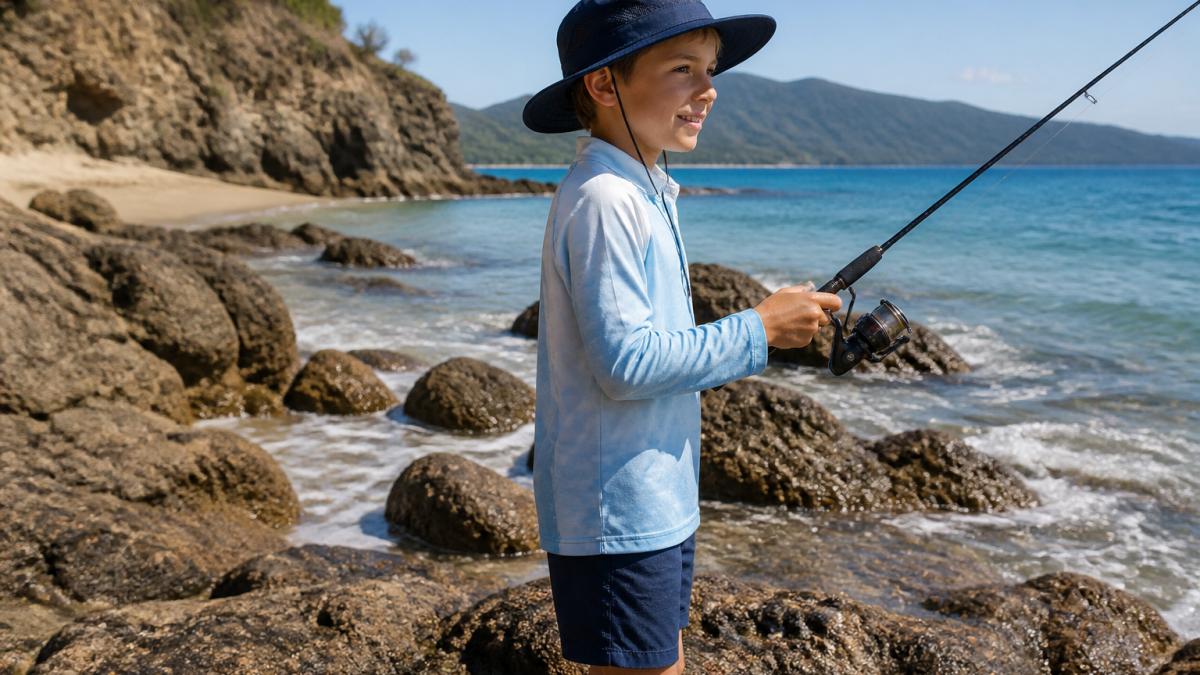
Lightweight fishing shirts for children benefit from a breathable weave, a quick-drying finish and a cut that lets air move. Kids run hot on the water, and a shirt that traps moisture becomes a shirt they refuse to wear. Look for lightweight fabric with a visible weave rather than a dense, plasticky feel.
Quick drying matters more than most parents expect. A wet shirt against skin loses much of its comfort and can chafe during a long day. Check the care label for fibre content when comparing shirts.
Kids' Fishing Shirt Sizing: Getting the Fit Right First Time
Kids' fishing shirt sizing should leave room to move without hanging loose enough to snag on tackle or ride up during casting. Children's fishing shirts are often sold in age bands, but age is a rough guide only, because two children of the same age can differ by a full size across the chest. Treat the age band as a starting point and the measurements as the decision.
Age-to-Size Guidance That Actually Helps
A common pattern in children's performance shirts is that the age band tracks height more closely than chest. Check the brand's own size chart, which will give height and chest ranges for each size. If your child is tall for their age, size by height first and check the chest measurement against the chart; if they are broad across the chest, size by chest and accept a slightly longer sleeve.
Measuring for a Fit That Allows Movement and Layering
Take two measurements: chest at the fullest point, and height from the floor to the top of the head. Compare both against the brand's size chart and choose the size that satisfies the larger of the two. A well-fitted fishing shirt sits close at the shoulders, allows a full arm raise without the hem lifting past the waistband, and leaves roughly a finger's width of ease at the chest. That ease matters because a sun shirt is often worn over swimwear or a base layer, and a shirt cut too close will bind across the back when your child casts or paddles.
Checking the Fit Before You Commit
Once the shirt arrives, run three checks before the tags come off: raise both arms overhead and confirm the hem stays below the waistband; make a casting motion and confirm the shoulder seam does not pull; and check that the cuff sits at the wrist bone rather than over the hand. If any check fails, size down or try a different cut.
Durability, Care and Comfort for Real Fishing Trips
Durability, care and comfort decide whether a shirt survives a season of fishing trips or falls apart by summer's end. Saltwater, sunscreen and repeated washing all attack fabric, and how you care for a garment matters as much as how it was built. Rinse after trips and wash cool where possible. Our guide on how to wash performance fishing gear walks through the full process step by step.
| Care step | What to do | Why it matters |
|---|---|---|
| After each trip | Rinse in fresh water | Removes salt and sunscreen residue |
| Washing | Cool machine wash, mild detergent | Protects fibres and finishes |
| Drying | Hang in shade | Preserves fabric and colour |
| Avoid | Fabric softener and hot dryers | Clogs fibres, reduces performance |
What Australian Made Fishing Clothing for Kids Should Cost
Australian made fishing clothing for kids generally costs more than imported fast-fashion equivalents, and that gap is worth understanding rather than resenting. Local manufacturing carries higher labour and compliance costs, and the price reflects construction, fabric quality and how long the garment lasts. Pricing depends on the range and current stock, so check the website for current prices.
Comparing Price, Shipping and Returns Honestly
Price on the tag is only part of the cost. When you compare options, put four things side by side: the country of origin stated on the label, the UPF rating and whether it is tested to AS/NZS 4399, the fibre composition, and the shipping and returns terms. A cheaper shirt with paid return shipping can cost more than a dearer one with free returns if the first fit is wrong. Check whether the brand publishes a size chart, its returns policy and its shipping terms. Those terms often matter more than a $10 difference in sticker price.
The Cost-per-Season Calculation
The honest question is cost per season, not cost per shirt. A cheap tee replaced twice a year often costs more than one durable piece that survives multiple summers. Work it out simply: divide the purchase price by the number of seasons you expect the garment to last. The cost-per-season calculation is simple: divide the purchase price by the number of seasons the garment lasts. Add the cost of sunscreen you would otherwise reapply more heavily, and the gap narrows further.
We do not publish fixed prices here because pricing depends on the range and current stock; check our site for current pricing. If you are weighing that trade-off, our guide on whether expensive fishing gear is worth it gives a practical view.
Join the Tide: Building a Sun-Safe Kit for Young Anglers
Building a sun-safe kit for young anglers comes down to a few deliberate choices: verify the manufacturing claim, check the UPF rating and its testing standard, get the fit right, and care for the garment so it keeps performing. Do those four things and you avoid the most expensive mistakes.
That is the standard we hold ourselves to at Coral & Cord. Our reef-inspired designs are built for adventure and designed for life on the water. Get started with Coral & Cord and join the Tide for launch updates and exclusive launch offers.
Frequently Asked Questions
Are fishing shirts for kids UPF-rated?
Many are, but the rating is only meaningful if it is stated on the garment and backed by testing to an Australian standard. Look for a stated UPF rating, and check whether the label says the protection comes from the fabric itself rather than a coating. A coating can wear away with washing. If the shirt has no stated UPF rating, treat it as ordinary clothing and pair it with sunscreen and a hat.
How do I choose the right size fishing shirt for a child?
Measure the child's chest and height rather than guessing from age, then compare those numbers to the brand's own size chart. Avoid sizing up too far, because an oversized shirt can ride up at the back and leave skin exposed. Check sleeve length reaches the wrist and that the hem stays down when the child bends or casts. If between sizes, take the smaller one for sun coverage.
What is the difference between a fishing shirt and a rash vest?
A rash vest is designed for swimming and tight contact with water, so it fits close to the skin and is usually made from stretchy chlorine-resistant fabric. A fishing shirt is cut looser for airflow, has collars, pockets and longer hems, and is built for hours of standing in the sun rather than immersion. For a day that mixes both, a lightweight fishing shirt over swimwear works well, with a rash vest underneath for swimming.
Are Australian-made fishing clothes available for kids?
Check the label carefully, as the label is the best guide to where a garment was made. Check whether the garment states it was manufactured here, not just designed here, and ask the brand directly where the fabric was cut and sewn. Treat a vague 'Australian owned' claim as a prompt to ask a specific question about where the sewing happened.
